Race Week, Arrived Properly
Hamilton Island Race Week returns from 15–22 August 2026, and the smartest arrivals are settled long before the first start gun. A brief on flying privately into the Whitsundays at the height of the winter season.

The one week the Whitsundays run on a different clock
Each August, Australia's premier offshore regatta takes over a single island in the Coral Sea. Hamilton Island Race Week, now in its 41st edition, runs from 15 to 22 August 2026, and the fleet has already passed 180 entries — from the 100-foot super maxi Wild Thing 100 down to trailer yachts, with Wild Oats X among the leading maxis. Onshore, the week has grown into something closer to a festival: long lunches, garden parties, spectator cruises, and a lay day built into the racing calendar.
The consequence for anyone flying in is simple. Demand for everything on the island — berths, pavilions at qualia, tables, and aircraft movements — concentrates into eight days. Scheduled services still run, but they run full, and they run to someone else's timetable. Flying privately is how Race Week regulars remove the one variable the regatta cannot control for them: the journey itself.
Why the runway decides everything
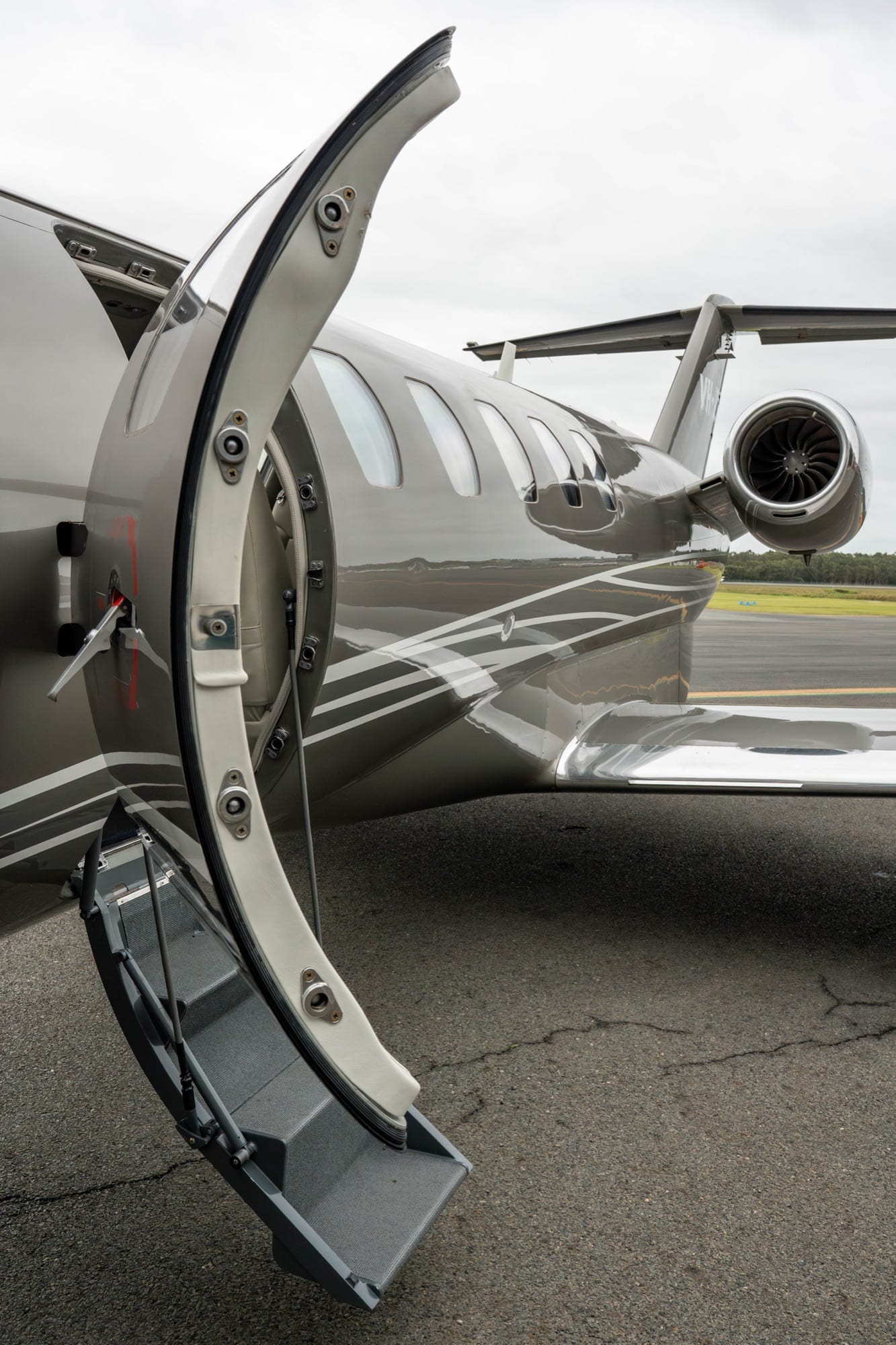
Hamilton Island is the only island in the Whitsundays with a jet-capable runway, and that single fact shapes every charter into the regatta. Great Barrier Reef Airport (HTI) sits on the island itself — minutes from the marina, a short buggy transfer from qualia at the northern tip — with a runway of 1,764 metres. That length suits light and midsize jets comfortably. Heavy jets are excluded — no matter how far you are travelling, the final leg must be flown on an aircraft the island can accept.
There is a further discipline to observe. HTI operates on a prior-permission-required basis, with published hours of 7.30am to 4pm. Slots into the island during Race Week are a managed resource, not an open door, and an arrival planned for late afternoon needs to be planned as exactly that — not hoped for. This is where a broker earns their keep: securing the permission, matching the aircraft to the runway, and building the day backwards from the island's operating window.
For larger aircraft, or for arrivals outside HTI's hours, Whitsunday Coast Airport at Proserpine on the mainland offers a longer 2,073-metre runway and an unconstrained apron — more flexibility for larger and heavier jets than the island's slot-limited strip — with the final connection made by air transfer or launch. It is a workable arrangement. It is also a compromise, and most guests, once they understand the runway arithmetic, choose an aircraft that lands where they are actually staying.
Which cities work best as departure points?
Brisbane is the most flexible origin on the east coast, because Brisbane Airport operates 24 hours with no curfew. A departure can be built entirely around your morning rather than around airport restrictions, and the flight north is short enough that breakfast at home and lunch at the marina is a realistic itinerary rather than a marketing line.
Sydney requires slightly more choreography. The sector to Hamilton Island is roughly 822 nautical miles — a little over two hours in a private jet — but Sydney Kingsford Smith enforces a curfew from 11pm to 6am, and private departures use the ExecuJet terminal at Mascot. Paired with HTI's 4pm cut-off at the other end, the workable window is real but finite. A mid-morning wheels-up from Mascot puts you on the island in time for the afternoon's racing with margin to spare. Aircraft rarely live where you need them, either; if the nearest suitable jet must reposition to collect you, that time is part of the plan, and it is our job to make it invisible.
When should the aircraft be booked?
For Race Week 2026, the honest answer is now. The regatta compresses a season's worth of light and midsize jet demand into one week in one direction, and the aircraft types HTI can accept are precisely the categories every other Race Week guest needs. Booking early is not about price — every JETPAX journey is priced individually against the market on the day, never from a tariff, with a firm all-inclusive quote. It is about choice: of aircraft, of departure time, of the slot into the island that suits your first evening rather than your second.
There is also the return to think about. Presentation night falls on Saturday 22 August, and the exodus on the Sunday is the busiest movement of the week. A departure secured in advance, timed inside HTI's operating hours, is the difference between leaving the island properly and queueing to leave it.
The season is longer than the regatta
Race Week is the headline, but it sits inside the Whitsundays' finest stretch of the year. The dry season runs from May to October — settled trade winds, low humidity, and the winter light that makes the reef photograph the way it does in memory. Guests who fly in for the racing increasingly return in September or October, when the island exhales and the anchorages empty out.
That shoulder period is also when empty legs appear. When aircraft reposition along the east coast after the winter peak, their one-way sectors are released at up to 75% off standard charter pricing — privately negotiated fares on aircraft already in motion. For a couple flexible on dates, it is the most considered way to see the Whitsundays out of regatta week. Tell us the window that suits you, and we will tell you what is moving.
Fly with JETPAX
Bespoke private charter, arranged in a single call — the aircraft, the crew and every detail of the flight.
Make an enquiryKeep reading